
Crimson and Clover
The Poetics of the Ghetto

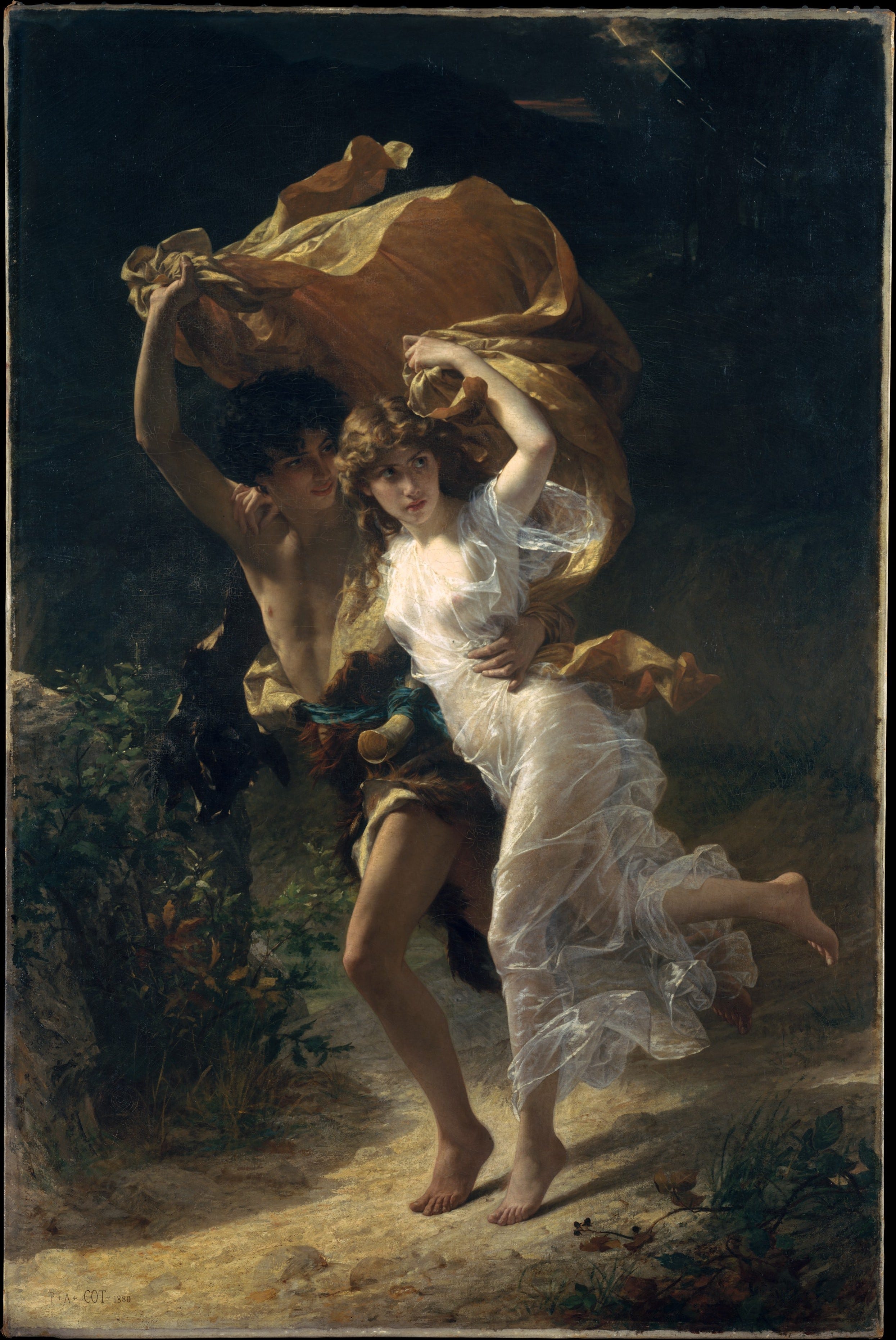
The Storm (Pierre-August Cot), a print of which hung in Alfred Kazin’s cousin Sophie’s room in Brownsville in the 1930s
Recently, hearing one of the many paeans to Allen Ginsberg on the 100th anniversary of his birth, I found myself thinking about one of his predecessors, the now largely-forgotten New York poet Charles Reznikoff. Reznikoff’s poem “I Will Go Into the Ghetto” has long been a favorite of mine.
I will go into the ghetto: the sunlight
for only an hour or two at noon
on the pavement here is enough for me;
the smell of the fields in this street
for only a day or two in spring
is enough for me.
This peace is enough for me;
let the heathen rage.
They will take away
our cakes and delicacies;
the cheerful greetings, the hours of pleasant speech, the smiles,
and give us back
the sight of our eyes and our silent thoughts;
they will take away our groans and sighs
and give us -- merely breath.
Breathe deeply:
how good and sweet the air is.
“I Will Go Into the Ghetto” was published in Reznikoff’s 1941 volume Going To and Fro and Walking Up and Down, and at each re-reading I find it deeply moving. I locate the ghetto of the title as Brownsville, Brooklyn, where Reznikoff was born to Russian Jewish refugees, and which his fellow Brownsvillian Alfred Kazin described as “that miserable working-class ghetto . . . which is one of the great cradles of Jewish life in the New World.” But even into such wretched places, cramped with want, Reznikoff suggests the inescapable intrusion of the pastoral, “the smell of the fields in this street/for only a day or two in spring.” Are these the fields of rye and sugar beets which he knew only as a second-hand memory from the Pale of Settlement, or the wide open spaces of the free American landscape echoed in miniature in Brownsville’s vacant lots? Whatever its source, their fragrance sustains the poetic sensibility even in the grimmest of circumstances, not unlike Wordworth’s host of golden daffodils that flashes upon the mind’s eye “in vacant, or in pensive mood” and stirs the imagination to life once more.
Years later, in the 1970s, Allen Ginsberg discussed Reznikoff’s poetry with a group of students and some Beat colleagues.
AG: His poetry is immortal. . . [Allen quotes Reznikoff’s “Jerusalem the Golden,” section 69] – “Among the heaps of brick and plaster lies/ a girder, still itself among the rubbish” – So in a thousand years time, they’ll still have these little fragments of poems, still themselves, “among the rubbish” – (71) “When the sky is blue, the water over the sandy bottom is/ green/ They have dropped newspapers on it, cans, a bedspring, sticks/ and stones/ but these the patient waters corrode, those a patient moss/ covers” . . . And here’s – (74) – a little composition, “The English in Virginia, April 1607” – it’s the last and caps all this modern stuff about beer cans, wrapping paper, subway mushrooms of chewing-gum, subway screeches and lights going on and off – [Allen reads Reznikoff’s “The English in Virginia, April 1607” in its entirety] – “They landed and could/ see nothing but/ meadows and tall trees…”…”In the twilight,/ through the thickets/ and tall grass,/ creeping upon all/ fours – the/ savages, their/ bows in their/mouths.” – So Reznikoff has a funny sense of humor to present this idyllic, primaeval glimpse as a “capper” to all his everyday time-capsule noticings.
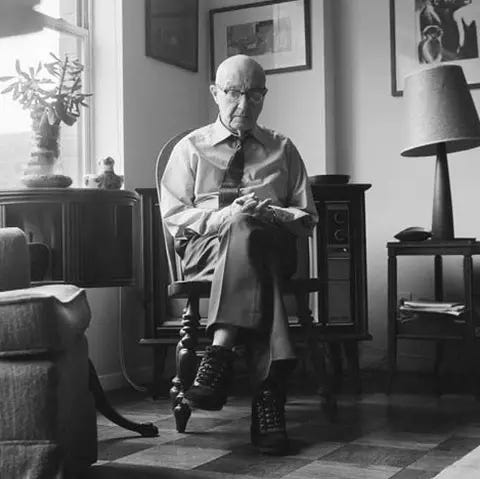
Charles Reznikoff (1894-1976).
Ginsberg also mentions a reading Reznikoff had recently given at the legendary St. Mark’s Church Poetry Project in the East Village:
AG: Last time he read there, I wept. It was just this old guy with such pure sight.
Larry Fagin: He still wears high-button shoes.
AG: Yeah, and he voted for Nixon!
Peter Orlovsky: He voted for Nixon?
AG: I couldn’t forgive him. I wept and couldn’t forgive him.
Student: Couldn’t forgive him?
AG: I can’t understand how he could notice everything in detail and still be a big dope.
Student: Didn’t you say he was Communist, or was that somebody else? [ Editorial note – Student is, perhaps, confusing Reznikoff with George Oppen here]
AG: No, I didn’t. no. (William Carlos) Williams, maybe, more. Well, no, Williams wasn’t Communist either..
Student: I don’t see how you could..
AG: And Mrs [William Carlos] Williams (Floss) was a little aghast at my family…
Student: Hmm?
AG: ...Because my mother was a Communist.
Yesterday I went down a Charles Reznikoff rabbit hole, which is admittedly a rather short and narrow one. The first thing I found was a review of a 2005 anthology in the New York Times. As I read the review, by someone called Joshua Clover, certain lines stood out: “Things mean themselves so thoroughly it’s crude and beautiful”; “Staggeringly, of all his books, this one evidently was written largely in Hollywood.” The writing was surprisingly clunky for a Times book review, so I wondered: who was this pastorally-named critic, Joshua Clover?
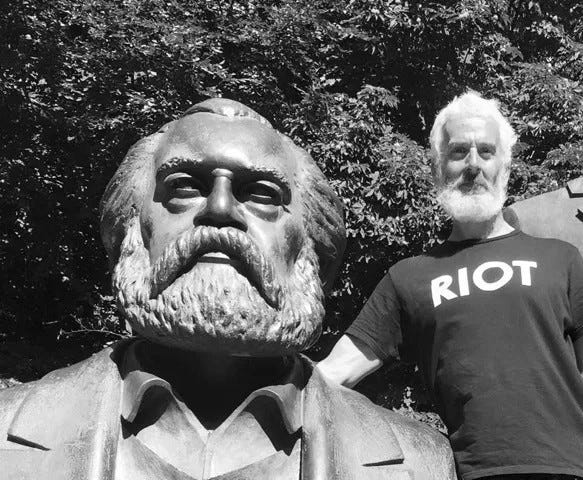
Joshua Clover and Karl Marx
I looked him up, and my heart sank a bit. Not only was Clover recently dead, but also, as an obituary by a colleague declared, all his work “was grounded in an enduring commitment to Communism.”
Joshua Clover was an English professor at UC-Davis. Another panegyric, on the blog run by the British leftist publishing house Verso (which published Clover’s book Riot. Strike. Riot in 2019), explains that although Clover felt ambivalent about working in academia, he ultimately “took the position that he had to fight within it because people struggle where they are, but he eschewed institutional reformism and had little faith in public institutions whose underlying commitments were to buttress the status quo.”
The Verso obituary continues:
Some months ago, one of us was texting with Joshua on a night when he was eating candy in bed and feeling sad. He asked if we had read any of the notes left on Marx's grave in London. We hadn't. You should read them sometime, he said; "They are the most unbearably moving sad documents in the world." They all basically read "Dear Karl, I'm sorry that we have not yet lived up to what you wanted for us, we'll keep trying, I promise."
And it concludes:
As we say goodbye to our friend and contemplate a vastly more impoverished world without him in it, this is a phrase we will keep repeating. We are sorry that we have not yet lived up to what you wanted for us. We’ll keep trying. We promise.
I admit that I found this moving, and the anecdote about Clover stress-eating candy in bed makes him seem like a sympathetic type. But when I read encomia like these about the astonishingly misguided idealism of contemporary intellectuals, an almost physical experience of depression descends over me. Clover does not seem to have left behind any survivors; one assumes that the revolution was his life and his comrades his family. And I think of my own family, made brittle by communism over generations, and can’t help imagining that — though in spite of his ambivalence about academia, as the son of professors he was to the manner born — Clover must have been a first-generation Communist. Because who at this late stage of history but a bedazzled convert, after seeing the effects of the communist project on one’s children, on the world, and on the human person writ large, would take it up where the previous generation laid it down?
I recently resigned from my job with an orchestra to work in arts-education consulting for children and youth with barriers to access. Towards the end of my time at my previous job I had a casual conversation about the FBI employment notices that come over my Indeed feed with some regularity: it seems the agency is always looking to recruit agents with a background in education, presumably to root out un-American activities in academia. I joked with a sometime colleague that, since I love reading spy novels and books about the history of espionage, I should sign up, but added that I probably wouldn’t pass a background check since my grandmother (also a native of Brownsville) had been a prominent Communist. My interlocutor gazed at me with wide-eyed admiration. “Oh, how cool!” she breathed.
It wasn’t worth it explain to her how it wasn’t cool; how my grandmother abandoned her husband and children for the revolution; how she lived underground for years; how her daughters were broken as a result, and passed the brokenness on. I also refrained from asking whether she would have thought it cool if my grandmother had been a member of the American Nazi Party.
I do not understand what it is about communism, which everyone knows by now has been responsible for the destruction of myriad cultures and the brutal deaths of tens of millions, that highly educated and reasonably well-off people find cool. The paeans to Joshua Clover were almost as worshipful as those to Allen Ginsberg. Am I missing something? I wondered. Can we in fact build a better world by dismantling the old one, and constructing in its place a new edifice that would at long last avoid disappointing Karl Marx? And if we did, would the poetry, the vision, of a Charles Reznikoff survive? After all, Allen Ginsberg himself declared Reznikoff’s work “immortal,” and, of the very lines Ginsberg used as evidence of this immortality, Joshua Clover also said:
"Jerusalem the Golden," runs in its length: "Among the heaps of brick and plaster lies / a girder, still itself among the rubbish." This exemplary couplet is sometimes taken to represent Reznikoff's poetry itself, immutable and certain amid the transitory.
Marx predicted that communism itself would be transitory, a temporary means to the condition of blissful statelessness, which Lenin confirmed would be by necessity accomplished through violence. What, I wonder, did Joshua Clover think the place of poetry would be in the prelapsarian paradise brought on by the violent establishment of the workers’ state, and then its eventual withering away? Would poetry aid in the revolution? What would be its place in the aftermath?
But I also must admit that, digging deeper into Clover’s oeuvre, I found some poems that I liked, including this one, “Ceriserie,” which has energy and humor:
Music: Sexual misery is wearing you out.
Music: Known as the Philosopher’s Stair for the world-weariness which climbing it inspires. One gets nowhere with it.
Paris: St-Sulpice in shrouds.
Paris: You’re falling into disrepair, Eiffel Tower this means you! Swathed in gold paint, Enguerrand Quarton whispering come with me under the shadow of this gold leaf.
Music: The unless of a certain series.
Mathematics: Everyone rolling dice and flinging Fibonacci, going to the opera, counting everything.
Fire: The number between four and five.
Gold leaf: Wedding dress of the verb to have, it reminds you of of.
Music: As the sleep of the just. We pass into it and out again without seeming to move. The false motion of the wave, “frei aber einsam.”
Steve Evans: I saw your skull! It was between your thought and your face.
Melisse: How I saw her naked in Brooklyn but was not in Brooklyn at the time.
Art: That’s the problem with art.
Paris: I was in Paris at the time! St-Sulpice in shrouds “like Katharine Hepburn.”
Katharine Hepburn: Oh America! But then, writing from Paris in the thirties, it was to you Benjamin compared Adorno’s wife. Ghost citizens of the century, sexual misery is wearing you out.
Misreading: You are entering the City of Praise, population two million three hundred thousand . . .
Hausmann’s Paris: The daughter of Midas in the moment just after. The first silence of the century then the king weeping.
Music: As something to be inside of, as inside thinking one feels thought of, fly in the ointment of the mind!
Sign at Jardin des Plantes: GAMES ARE FORBIDDEN IN THE LABYRINTH.
Paris: Museum city, gold lettering the windows of the wedding-dress shops in the Jewish Quarter. “Nothing has been changed,” sez Michael, “except for the removal of twenty-seven thousand Jews.”
Paris 1968: The antimuseum museum.
The Institute for Temporary Design: Scaffolding, traffic jam, barricade, police car on fire, flies in the ointment of the city.
Gilles Ivain: In your tiny room behind the clock, your bent sleep, your Mythomania.
Gilles Ivain: Our hero, our Anti-Hausmann.
To say about Flemish painting: “Money-colored light.”
Music: “Boys on the Radio.”
Boys of the Marais: In your leather pants and sexual pose, arcaded shadows of the Place des Vosges.
Mathematics: And all that motion you supposed was drift, courtyard with the grotesque head of Apollinaire, Norma on the bridge, proved nothing but a triangle fixed by the museum and the opera and St-Sulpice in shrouds.
The Louvre: A couple necking in an alcove, in their brief bodies entwined near the Super-Radiance Hall visible as speech.
Speech: The bird that bursts from the mouth shall not return.
Pop song: We got your pretty girls they’re talking on mobile phones la la la.
Enguerrand Quarton: In your dream gold leaf was the sun, salve on the kingdom of the visible.
Gold leaf: The mind makes itself a Midas, it cannot hold and not have.
Thus: I came to the city of possession.
Sleeping: Behind the clock, in the diagon, in your endless summer night, in the city remaking itself like a wave in which people live or are said to live, it comes down to the same thing, an exaggerated sense of things getting done.
Paris: The train station’s a museum, opera in the place of the prison.
Later. The music lacquered with listen.
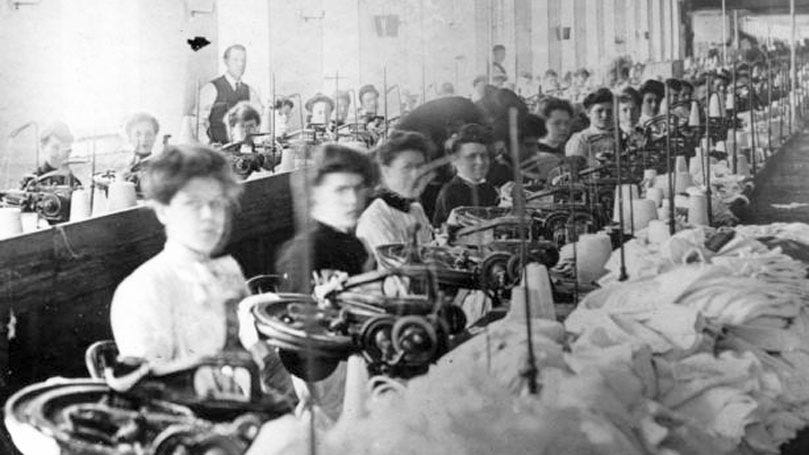
Jewish immigrant garment workers, New York, c. 1913.
In his second memoir, Starting out in the Thirties, Alfred Kazin writes at length about his cousin Sophie, who lived with his family in their shabby Brownsville flat and, in spite of toiling long hours in a sweatshop, imbued it with a spirt both of poetry and of sensuality:
All my life I had seen her, with the long black hair which had never been cut, her embroidered Russian blouses and velvet skirts . . . off in her room under the picture of the two lovers fleeing from the storm [“The Storm,” by Pierre-Auguste Cot, pictured above], or in the kitchen with her friends from “the shop,” drinking tea, eating fruit, or playing at the mandolin . . . How natural it had always been . . . to steal into her room to smell the musk, the patchouli, the stingingly sweet face powder, the velvet skirts whose creases seemed still to mark the pressure of her body, the slips whose straps seemed just to have slipped off her shoulders . . . Loneliness had become her profession. It glowered in her like a passion and was her passion, so that by contrast with her friends from the shop, unmarried like herself, she seemed quicksilver, menacingly alive, radiating heat, a sullen fire. . . an immigrant dressmaker no longer young [who] lived for love.
In his magisterial history World of Our Fathers, Kazin’s contemporary and fellow New York Intellectual Irving Howe describes the turn to a kind of bohemian aestheticism on the part of young ghetto women like Sophie:
[A] small group of young [immigrant girls] . . .tried to model themselves on the styles of the late-nineteenth-century Russian intelligentsia. Tame enough by later standards but inspired by a genuine spiritual loftiness, the style of these young immigrants might be described as a subdued romanticism, a high-minded bohemianism. . . . What stirred [them] . . . was not so much an explicit social ideology as their fervent relation to European culture, their eager reading of nineteenth-century Russian and English novels.
In Kazin’s and his cousin Sophie’s milieu, radical politics were an unremarkable part of everyday life, walking hand in hand with labor’s efforts to improve the deplorable conditions of immigrant workers. Though steeped in an atmosphere of reflexive socialism, Kazin was not a Communist; in his memoir, he is clear-eyed about Stalin, and at one point describes a socialist rally at Madison Square Garden that devolved into a riot when Communists attempted to hijack the podium and hurled chairs at the socialists from the balconies. One critic describes Kazin as “an emotional slavophil,” which is no doubt what his cousin Sophie also was with her Russian novels, her embroidered blouses, and her other attempts to impart beauty and meaning to her downtrodden daily life. The life of emotion, of the interior world, becomes a means of liberation from the drabness of circumstance.
And perhaps this is what Joshua Clover and his cohort also want, a redistribution or redefinition of what is beautiful. Perhaps, though they enter into radical political action with a kind of noblesse oblige that comes from extreme privilege and unfettered access to Paris, to Walter Benjamin, to Theodor Adorno, to museums and the opera, they share with Tolstoy a deep suspicion of beauty, preferring their art to be ethical and didactic rather than sublime. But is Clover’s poetry ethical or didactic? Is it comprehensible to the masses he wishes to liberate?
It appears that Joshua Clover was at his most effective not as an activist but as a mentor of graduate students and fledgling poets. As poet Sandra Simonds writes in her obituary:
When he visited my Poetic Forms class on Zoom, I thought we would talk about line breaks or meter. Instead, we discussed Marx, metaphor, and [rappers] Public Enemy. He treated my students, many from disadvantaged backgrounds and with little formal exposure to poetry, with genuine respect. I remember him calling the sonnet “a jail cell with better acoustics,” which my students loved.
Clover didn’t love the poetic form of the sonnet, which is fine, beauty being in the eye of the beholder and all that. But I wonder if dragging the form counts as treating students with genuine respect. As teachers, scholars, and practitioners of the classical arts, does minimizing or withholding the richness of form and tradition from students unaware of them constitute respect, exactly? If Clover has access to the form of the sonnet, shouldn’t he dismantle the barriers for everyone?
Maybe it is my own kind of noblesse oblige that leads me to believe the classical arts are for everyone, and to brainstorm ways to bring them to young people who, like most of us, lack Cousin Sophie’s gift of turning an overcrowded tenement room into a temple of the soul. Be that as it may, and stumble as I may, I am quite convinced that communism can never accomplish this.
This was a great post, Julia; sorry that it took me such a long time to get around to reading it.
I was introduced to the poetry of Charles Reznikoff in one of my several poetry classes that I took in the late 1970s at The Cooper Union. (St. Mark's church was on my walk to school for my last two years there.) I was studying engineering and the three (I think) poetry classes I took were a welcome respite from the rigors of the engineering curriculum.
But we didn't spend much (probably not enough) time studying the work of established poets; these were mainly poetry-writing workshops. Because of that I didn't retain a lasting memory of Reznikoff's work.
I, too, ponder the mystery of people thinking Communism is cool. I think it must be partially because they've never had to live under it. I used to think it was because they were lazy, and desperately wanted the wealth of others distributed to themselves. But some of them that I've known are not lazy at all. Many seem to loathe American culture and I think are simply trying to find something as far from that as possible. Too, I think that there is something of what G. K. Chesterton described thusly:
"The modern world is full of the old Christian virtues gone mad. The virtues have gone mad because they have been isolated from each other and are wandering alone. Thus some scientists care for truth; and their truth is pitiless. Thus some humanitarians only care for pity; and their pity (I am sorry to say) is often untruthful.”